
Frequently Asked Questions
What to Expect
We know looking for a reliable Florida concrete specialist can be a challenge and we want our customers to be well informed. Alex Cor, Inc is a leading concrete company that specializes in a wide variety of concrete projects like commercial flooring, structural concrete, paving, masonry, and more. Our goal is to make sure your job is complete on time and on budget.
Why do you place concrete so early in the morning?
Starting early in the morning isn’t just a preference, it’s a necessity driven by climate, quality, and performance.
Cooler morning temperatures slow down concrete hydration, giving crews more working time to properly place, finish, and cure the slab. As the day heats up, concrete can set too quickly, increasing the risk of surface defects, plastic shrinkage cracking, and uneven finishes.
Early starts also help us avoid peak afternoon heat, intense sun, and the frequent pop-up storms common in Florida. Fewer weather interruptions mean better consistency, safer working conditions, and higher-quality results.
By placing and finishing concrete early in the morning, we’re able to maintain control over the process – delivering flatter, stronger, and more durable slabs built to perform long after the pour is complete.
What are FF and FL numbers?
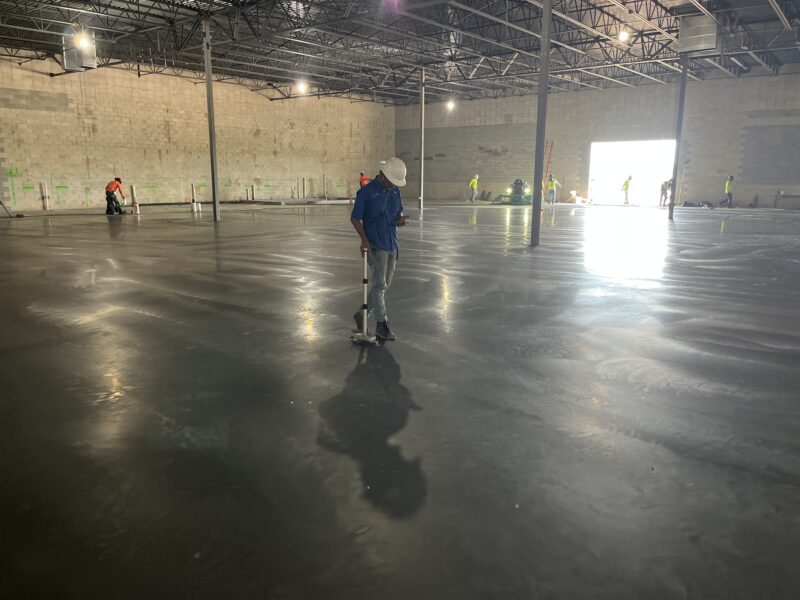
When it comes to commercial concrete floors, how flat and level a slab is matters just as much as its strength. That’s where FF and FL numbers come in.
FF (Floor Flatness) measures how smooth a concrete floor is over short distances. It captures surface waviness, which directly affects things like ride quality for forklifts, equipment vibration, and the overall appearance of the slab.
FL (Floor Levelness) measures how level the slab is over longer distances. This is especially important in warehouses, distribution centers, and manufacturing facilities where racking systems, drainage, and equipment alignment rely on consistent elevation.
How they’re used:
✔️ Measured using specialized floor profilers after concrete placement
✔️ Compared against project specifications and industry standards
✔️ Used to verify slab quality and performance before turnover
What they tell us:
✔️ Higher FF = smoother surface
✔️ Higher FL = more consistent elevation
Together, they confirm whether a floor meets the demands of its intended use
FF and FL numbers give owners, designers, and contractors a clear, objective way to evaluate slab performance — and help ensure commercial floors are built to function efficiently, safely, and for the long haul.
What is a Finishing Aid
In commercial concrete construction, surface quality and long-term durability matter just as much as strength. That’s where a finishing aid, specifically colloidal silica, comes into play.
Colloidal silica is a liquid admixture applied to the surface of fresh concrete during finishing. It works by reacting with free lime in the concrete to form additional calcium silicate hydrate (CSH) — the same compound responsible for concrete’s strength. This reaction helps tighten the surface and improve overall performance without adding water.
Why we use it on commercial slabs:
✔️ Improve finishability without weakening the mix
✔️ Reduces surface tearing, dusting, and premature drying
✔️ Enhances surface density and abrasion resistance
✔️ Helps deliver a flatter, harder, more durable slab
In large commercial pours where timing, consistency, and performance are critical, finishing aids help us achieve high-quality results while protecting the integrity of the concrete. It’s another tool we use to ensure slabs are built to perform — not just on day one, but for years to come.
What are Admixtures?
Concrete isn’t just cement, water, and aggregate anymore. Advances in chemical admixtures now allow commercial concrete to perform reliably in hot weather, cold weather, and accelerated construction schedules – all while maintaining strength, durability, and finish quality.
How does it works?
🌵 Hot Weather Admixtures:
In high temperatures, concrete can set too quickly, increasing the risk of cracking and finish issues. Set retarders and hydration stabilizers slow the chemical reaction, giving crews more working time and allowing for proper placement, finishing, and curing.
❄️ Cold Weather Admixtures:
Cold slows hydration and can prevent concrete from gaining early strength. Non-chloride accelerators help concrete gain strength faster without risking corrosion of reinforcing steel, allowing placements to continue safely in cooler temperatures.
⏩ Accelerated Schedule Admixtures:
When schedules are tight, high-range water reducers (superplasticizers) and early-strength accelerators increase strength gain without adding extra water. This allows for earlier saw cutting, faster form stripping, and quicker access for follow-on trades.
💨 Air-Entraining Admixtures:
For exterior concrete, these admixtures intentionally create microscopic air bubbles that improve freeze-thaw durability which is critical for pavements, docks, and slabs exposed to the elements.
Why It Matters:
The right admixture package means:
✔️ Better quality and consistency
✔️ Reduced cracking risk
✔️ Improved durability and longevity
✔️ More predictable schedules
Concrete today is engineered, not just mixed. And thanks to modern admixtures, high-quality placement is possible in conditions that would have been major obstacles just a decade ago!

Let an expert guide you.
With years of experience in the concrete industry, we are committed to delivering efficient, reliable solutions for commercial clients seeking expert support on their concrete projects.

You must be logged in to post a comment.